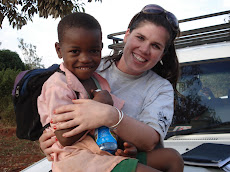
Eileen is Programmes Co-ordinator for the overseas development agency World Vision Ireland. Based in Nairobi in Kenya, she supports programmes funded by Irish child sponsors and the Irish Government. Here she reports on her experiences, living and working in East Africa.

Showing posts with label Irish Aid. Show all posts

Friday, May 7, 2010

Water for dignity

By Evelyn in Kenya
I recently read an interesting, yet rather disturbing, statistic which stated that millions of women around the developing world spend up to a third of their lives fetching water. This made me think of how much of our lifestyle (e.g. my 30 minute long showers) is made possible by a reliable supply of clean water.
It also made me think of how much clean water and sanitation can do for the freedom and dignity of people, especially women and girls. Fetching water is a backbreaking household chore that usually falls to women and girls in many parts of the developing world. This is the case in Busia, Eastern Uganda, where Irish Aid has supported the construction of 8 boreholes, which provide a supply of clean water for 2,100 households. Community Groups in charge of Water In a recent trip to Uganda, Eileena and I visited these boreholes and got a chance to speak with the community members. Each borehole is managed by a water users association made up of elected members from the community (both men and women) that have received training on how to manage and maintain the water source.
They collect a small fee from each community member, which is then saved up to pay for future borehole repairs.
What's great about this set up is that the community have control over the borehole and know how to fix it when repairs are needed. A 10k walk for water Prior to the construction of these boreholes, the women and children, mainly girls, were forced to walk up to 10 km to fetch water, often from dirty streams or ponds. It was no surprise then, that the women were the most vocal when it came to articulating the benefits the clean water of supply has brought to their lives. Rose Naja, who had a family of 9 children, told us how she could only collect 2 or 3 Jerri cans of water per day because the distance was too far for her to carry back any more water. When the needs of collecting water got too much for her manage, her daughters would be forced to drop out of school to help her collect enough water for the family. Lives changed for the better These boreholes and the clean supply of water they provide has had a significant impact on the lives of these communities, especially that of women and children. The women can now collect enough water to meet all their household needs in 30 minutes. Time spent fetching water can now be spent on performing other household activities, farming or going to school. Also, their children are no longer constantly sick with diarrhoea and dysentery. Through the support of Irish Aid, these communities can now enjoy the freedoms and dignities a clean supply of water can offer- better hygiene, less illnesses and more time to engage in productive activities.
By Evelyn in Kenya

Friday, April 9, 2010

Finally the rains come to Kenya

And then there was rain… Rain has finally come to Eastern Kenya (and most of Kenya). Driving through Mwala, I am amazed at the difference in the landscape. The fields are now lusciously green and filled with crops. The once dried rivers are now full. The heavy rains have turned the roads into a ‘four wheel drive only’ zone and part of our afternoon is spent trying to extract our heavy-duty 4x4 from the riverbed. Looking at this scenery, one would think Mwala is a fertile area with high food production. “Visit during September/October and you will not believe it is the same place - it will be very dry and dusty,” says Frank Meme, the Mwala programme manager. “Last year’s drought and the resulting famine were extremely severe; the community was forced to rely on relief food”, he reminds us. Evelyn and I were off to visit an Irish Aid funded project in Mwala ADP, to check up on how your tax contributions have been put to work! At last, enough food! After a long, bumpy drive, we arrived at the Wali Imwe Ndigua (one piece of cloth cannot make a dress) farmers group to a red carpet welcome. Each group member told us how this project, coupled with the great rains, has drastically increased his/her yield. This farmers group had been trained in improved farming methods and received crop seeds, fruit tree seedlings, farming equipment and livestock (Galla goats and cockerels). This has dramatically improved the group’s ability to fend for themselves: For example, the group’s treasurer told us that he has harvested 500kg of maize compared to 30kg of maize the previous season. Each group member contributes a small amount of their harvest to be stored and used as seeds for the next season. The surplus food is sold at the market and the profit used to benefit the group and promote their development. The group is determined to work their way out of poverty: “Hatutaki watu wa hiki kikundi wasikie njaa tena” (we don’t want our group members to go hungry again), the group’s Chairman told us. Water Kiosks At another project site, pointing to some far off hills, the Secretary for the Water Users Association recalls the long distances community members would walk to fetch water. Irish Aid funded a food security project which enabled the construction of a borehole, water tank and eight water kiosks in this drought prone area. Water from the borehole is pumped to the water kiosks where it is distributed to community members at an affordable rate. These kiosks are placed at convenient locations, reducing the distance community members walk to fetch water. Previously, people were walking up to 20km to fetch water, which meant entire days were wasted just trying to get water. To compensate for the lack of water, clothes went unwashed and bathing became a luxury. This led to the outbreak of skin diseases and water borne diseases – misery. Making a difference Despite the brevity of our visit, it was clear that the community were 100% behind the project and were maximising all opportunities given to lifting themselves out of poverty. I was deeply humbled by their welcome and gratitude for the help they have received from Irish Aid through World Vision Ireland. I was moved by the sense of accomplishment in their voices when they showed us their crops and livestock and their hope for the future. This visit reminded me of the reason for which we do this work- we are transforming lives and restoring hope. By Evelyn in Kenya

Friday, November 20, 2009

Life's a beach

There’s an old Swahili saying “Mambo ya pwani si mchezo”, which means that life at the coast isn’t a game. On the surface, this is hard to believe – the Kenyan coastline is beautiful and life moves at a sumptuous, leisurely pace. Drive a few kilometres inland though and life is anything but a game. This is one of the poorest and most disenfranchised areas of Kenya. Three years of consecutive drought have left tens of thousands on relief food and the rations are never quite enough. There are hundreds of moderately and severely malnourished children. Before the rains arrived this season, the closest water points were a 60km cycle away. And the place is so full of poisonous snakes that Steve Irwin filmed an episode of Crocodile Hunter out here. No Complaints But people aren’t sitting around moping or complaining about their misfortunes. Anything but. Despite six consecutive crop failures, they have prepared and planted their land. This is back breaking work under an unforgiving sun, which seems to promise yet another drought. 'Poverty tourism' I was there for three days this week visiting an Irish Aid funded food security recovery project and it is one of my favourite projects in the country. I’ve even brought friends to visit it while they were over in Kenya. They were reluctant at first, fearing that it would be a depressing and somewhat invasive “poverty tourism” trip. They actually found the opposite. Heart warming hospitality When we stepped out of the car, we were met by large crowds of women and men singing our welcome. Despite barely having two beans to rub together, they rolled out the red carpet for us. They sang us songs with our names woven in and gave us an array of gifts including chickens, a handmade bag with my name woven into it, and an assortment of spoons, as a thank you for our support. When they saw me melting under the jua kali (fierce sun) they lent me a kanga to cover my head with. I can’t begin to explain how humbling and heart-warming their hospitality and generosity is. It’s also astute on their part – charming visitors encourages them to be generous in return. I always leave wishing there was more we could do. Food and Water World Vision Ireland has achieved a lot in the past three years in this area. In partnership with the community, we constructed rain water harvesting tanks and reservoirs (as shown in the photos) which can store water for the next few months – some even until the next rainy season. When the drought was at its worst, the government trucked in water and filled the tanks, which meant an end to the 60km cycles. We’ve also trained farmers on improved agricultural methods, which helped them to capitalise on what little rain there is. A major success it the super goats that were given from the world vision gift catalogue – many kids have been produced, which means more milk, meat and money for families. I just pray that the rains come back.

Tuesday, November 10, 2009

Growing food when the odds are stacked against you.

I just got this great story in today from Muranga where Irish Aid and World Vision Ireland have been running a food security recovery project in Muranga in Central Kenya. The goats and seeds that people buy from the World Vision Ireland gift catalogue have also been helping make this project the success that it is. It’s been running for over 2 years now and I visited it again last week. The farmers I met told me that they have been able to quadruple the amount of food they produce! Jane Wanjiru Mwaura is one the best examples. Jane is a retired nursery school teacher and mother of five children. She owns just a quarter acre of land and depends on this for her livelihood. She joined Kamaka Self Help Group in 2007. Through the project, Jane and her fellow group members received training on improved farming practices and water conservation techniques. After the training, Jane dug 450 zay pits, which are 2x2x2 foot holes that promote soil fertility and water conservation. Zay pits are hard work to dig, but the results are well worth the effort - she harvested some 800kgs of maize last season. This was more than enough to feed her family and to sell for hard cash. Jane has become a model to others in her community. She trained her six neighbours and they too have started reaping the benefits of zay-pits. Jane said “From the training, I have been able to revolutionise my farming. I even get crops when the rains are poor, while other farmers using traditional methods are not harvesting anything.” On World Food Day, Jane was awarded a certificate by the UN Food and Agriculture Organisation (FAO) and the Ministry of Agriculture for being one of the best farmers in the district. But she won’t stop there: She says “My intention now is to train more farmers in my are to be self-sufficient in food production”. Happy days.

Wednesday, September 30, 2009

Packing for Somalia

I’m off to Somaliland in two weeks time to participate in an Irish Aid funded project evaluation (Somaliland is an autonomous region in North West Somalia). I’m looking forward to it; it’s a fascinating part of the world. It sounds far more adventurous than it is though - where we’re going it’s relatively peaceful and stable.

What to wear

I need to find appropriate clothes for the trip. The hejab (a long dress) and the headscarf aren’t wardrobe staples of mine. I’m a fan of both: The headscarf means bad hair days can be forgotten about and the hejab is super comfy and stops me from getting burnt to a crisp. Fortunately for me, my friend Sofie has a good supply of both and is happy to lend them out.

FGM

The project that we’re evaluating is funded by Irish Aid and aims to reduce the practice of female genital mutilation (FGM) in the area. The practice is widespread in Somalia, as most people believe that it is an Islamic requirement.

In fact, it is not and Muhammad never subjected his wife or his daughters to it. But saying "no" to FGM is not easy, as you are likely to face ridicule from your peers and may find it very difficult to get a husband.

From preliminary reports, the three year project has helped reduce the practice of FGM in the area. I’m looking forward to finding out more, particularly what encouraged people who have stopped to do so. I'll keep you posted on my experiences out there!